
How Bench Warrants Work in Titus County
People say bench warrant for nearly anything a judge issues after a missed duty. The label can cover a skipped appearance, a disobeyed order, or another unmet court obligation. Titus County records use sharper terms in some courts. Mount Pleasant calls the writ that follows unpaid fines a capias pro fine, and it describes a warrant of arrest after a failure to appear or pay within its stated period. The exact name matters. It points to the right court. This kind of process can begin in district, county, JP, or municipal court. The clerk finds the case record. The judge or magistrate still controls the order, any bond, a new date, and a recall or quash decision. So ask which Titus County court issued it. Missed dates do not land on one list.
Titus County’s Two JP Warrant Routes
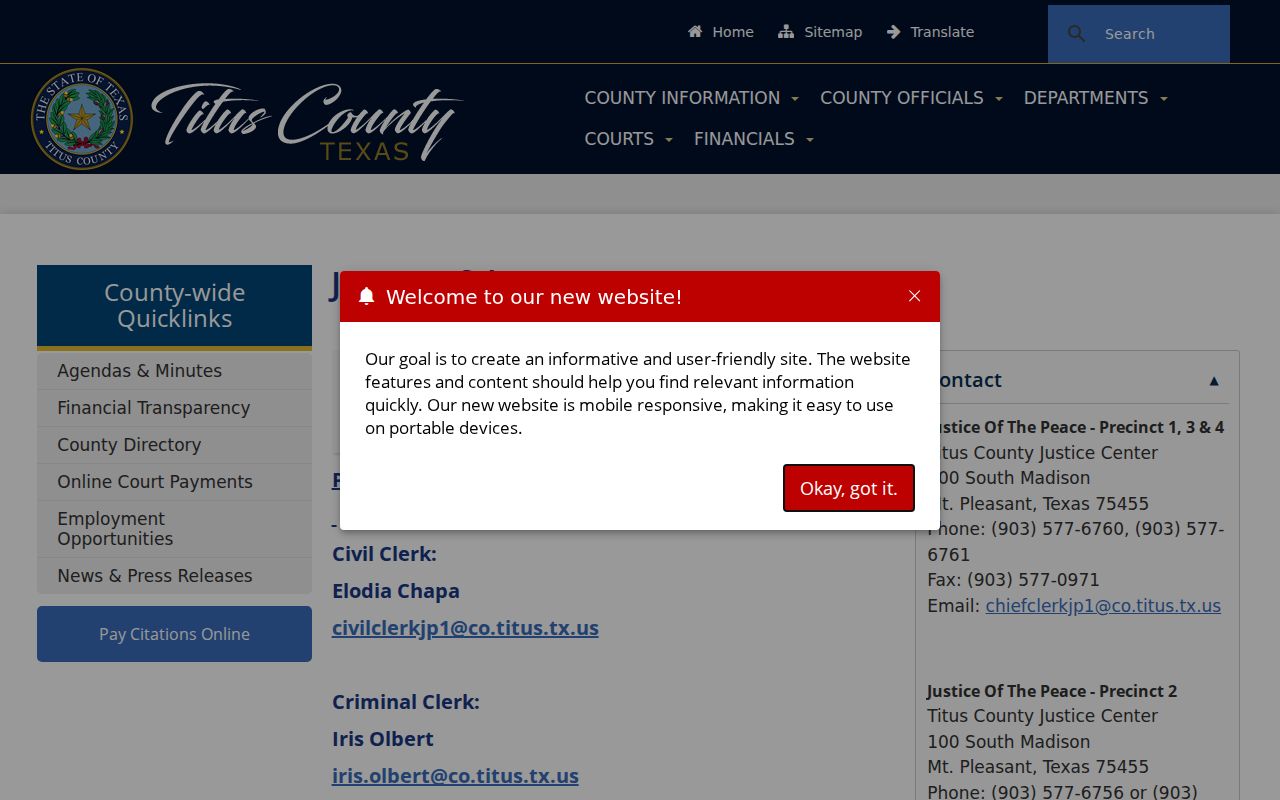
Titus County runs two JP office groups, not one shared criminal desk. Precincts 1, 3, and 4 go through a criminal clerk at 903-577-6761. Precinct 2 uses 903-577-6757. Your citation or court notice names the precinct. Call that Titus County clerk with the citation number and ask whether the issue is a missed setting, an arrest warrant, or a capias pro fine. The county JP page lays out the office grouping, clerk contacts, written forms, and ticket instructions. It also links to an online citation-payment vendor. That vendor does not display current warrant-status fields. A payment alone does not end a bench process.
Bench Warrant Issuance in Titus County
What triggers issuance depends on the court event. A person may miss a scheduled setting, ignore a court order, or leave a fine judgment unpaid past its terms. Texas Chapter 45A supplies the lower-court framework for JP and municipal cases. Article 45A.259 covers the capias pro fine when a judgment stays unsatisfied. A judge or justice authorizes the process. An officer serves it. The clerk's case entry may show a setting, a payment, a return, or a later order. Titus County publishes no public code dictionary for those entries. So ask the court to name the exact process and explain what must happen next. That keeps a reminder, an FTA notation, an arrest warrant, and a fine writ from blurring together. Each one leads somewhere different in Titus County.
Mount Pleasant’s Capias Pro Fine Warrant
Mount Pleasant, in Titus County, posts its own explanation of the fine-collection process. A capias pro fine can follow a broken payment arrangement. It adds $50 per offense. The court says a defendant may avoid arrest by paying at least half of the total fines and keeping the original arrangement going. A 30-day extension can be requested at plea. Longer payment agreements carry a $25-per-offense charge. Those numbers govern Mount Pleasant only, not all of Titus County. Your balance, eligibility, and approval must come from Mount Pleasant's official warrant page and Municipal Court. Do not treat the listed PDF amount as bond. A payment alone does not change the docket.
How Bench and Arrest Warrants Differ
The difference is the reason. A bench warrant follows a missed court duty or order. An arrest warrant starts with a probable-cause process for an offense. A capias pro fine ties to an unpaid judgment. Any of the three can direct a Titus County officer to take someone into custody, though the case and the court's instructions set the next step.
| Process | Typical local context | Who confirms it |
|---|---|---|
| Bench process | Missed appearance, order, or court duty | Court that set the date |
| Arrest warrant | Sworn complaint or other authorized arrest process | Issuing court or magistrate |
| Capias pro fine | Unpaid judgment under court terms | JP or municipal court |
Titus County Bench Warrants After Missed Dates
Start with the notice or citation if a date was missed. Call the court before walking in. Ask whether a new setting is open, whether a written plea is required, whether bond applies, and whether a lawyer can arrange a walk-through. The JP traffic instructions say pleas are written. They outline guilty, no-contest, deferred-disposition, and driving-safety-course routes. Those options turn on the case and its deadline. For a district-court or felony setting, contact the District Clerk or court coordinator and talk with Texas counsel before acting. Titus County posts no countywide surrender form, universal recall motion, or bond-window schedule. Keep the written setting notice, payment receipt, or order. The next person you call in Titus County can then trace what changed.
Clearing a Bench Warrant in Titus County
Ask the issuing clerk first. The clerk confirms status and explains the permitted cure before you pay or appear. City and JP matters may point to payment, a written plea, a new setting, deferred disposition, or a judge-approved arrangement. Felony, family, and contempt matters call for counsel. Ask about bond, surrender, or a motion to recall or quash. A payment receipt does not close the underlying case in Titus County, so keep going until the court says the warrant is handled.
- Match the process to the court and case number.
- Ask whether an appearance, plea, payment, bond, or motion is required.
- Get any new date and payment terms in writing.
- After the court acts, ask how to confirm the warrant status and any reporting update.
Warning: Titus County has not posted a standard walk-in surrender or bond-window procedure; ask the issuing court or counsel before traveling.
Titus County Bench Warrant Records
A Titus County court file can hold the cause number, issuing judge, charge, date of issue, bond terms, service return, and later status entries. Mount Pleasant's public PDF is much narrower: ticket, violation, sequence, offense, type, amount, and city. No countywide status code comes with it. The district courts post no sample bench-warrant record. Service and recall differ. The Sheriff's Office or a constable may report that a Titus County warrant was served. The issuing court's docket shows the court-side action. A Texas Public Information Act request can produce a record that already exists in a file. Law-enforcement, sealing, juvenile, or court-order limits may still apply.
Titus County Courts That Issue Bench Warrants
Titus County splits its bench-warrant work across several courts. Titus County's District Clerk backs the 76th and 276th Judicial District Courts for felony and district settings. County-court misdemeanor records run through the County Clerk. Two JP criminal-clerk offices split traffic and lower-level cases. Mount Pleasant Municipal Court handles ordinance and Class C matters. Winfield's court appears in OCA materials, but the public route runs through City Hall. Talco names no confirming court. The county directory separates clerk, sheriff, and constable contacts, and the Sheriff's Office and constables publish their warrant-service roles. Which agency served a given warrant is not stated, so ask the issuing court where the signed process went and which office can confirm its present status.
Which Clerk Keeps Titus County Bench Records
Two offices split the paperwork in Titus County. The District Clerk holds the files for the district courts, while the County Clerk keeps misdemeanor and Class C appeal records from the county courts. A copy request only reaches papers already in a file. Bond, current status, and a new court date belong to the judge, not the clerk. Clerks can point a request the right way. They cannot stand in for a court order. If you do not know which court issued the warrant, pull the cause number and ask which clerk keeps that docket. The Sixth Court of Appeals handles appeals, so it is not the place to start a warrant check. Even when a neighboring district contact shows up in a Titus County case, the court number and cause number decide where the request goes. The county's JP page lists its precinct offices and criminal-clerk groups, so match the printed precinct before you follow up.
The Titus County courthouse holds separate court routes under one roof, so the precinct, not the building address, picks the right clerk.